TL;DR:
- Thousands of European patients choose Turkey for affordable, high-quality medical and dental treatments each year. Turkey’s accredited facilities, experienced doctors, and all-inclusive support packages ensure safe procedures with significant cost savings. Selecting clinics with proper accreditation, transparent pricing, and qualified surgeons is essential for achieving optimal outcomes abroad.
Thousands of European patients are choosing Turkey for medical and dental treatments every year, and the reasons go well beyond price. The question of why choose clinics in Turkey comes up repeatedly among those who have received quotes from UK or Western European providers and found them out of reach. Turkey offers a combination of accredited facilities, internationally trained doctors, and all-inclusive packages that address the full treatment experience. This guide covers the evidence behind Turkey’s reputation, what quality standards actually look like on the ground, and how to identify the right clinic for your needs.
Table of Contents
- Key takeaways
- Why choose clinics in Turkey for treatment costs
- Quality and safety standards in Turkish clinics
- Clinical expertise and volume of procedures
- Comprehensive support for your treatment journey
- How to choose the best clinic in Turkey
- My perspective: what working with patients teaches you
- How Clinicgroup connects you to trusted Turkish clinics
- FAQ
Key takeaways
| Point | Details |
|---|---|
| Significant cost savings | Patients typically save 50–80% on procedures compared to UK and Western European prices. |
| Accredited facilities | Turkey has 41 JCI-accredited hospitals meeting internationally recognised safety and quality benchmarks. |
| Experienced specialists | Turkish doctors hold board certifications, often with additional international training and professional body memberships. |
| Full journey support | Verified clinics offer all-inclusive packages covering accommodation, transfers, language support, and aftercare. |
| Choose carefully | Checking accreditation, surgeon credentials, and transparent pricing protects you from substandard providers. |
Why choose clinics in Turkey for treatment costs
The most immediate reason patients look to Turkey is the financial difference. Savings of 50–80% are consistently reported by international patients compared to the same procedures in the US, UK, and Western Europe. That is not a marginal discount. For someone facing a full dental implant treatment costing £15,000 at home, the same procedure in Turkey could come to between £3,000 and £6,000 at a reputable clinic.
These savings are not the result of corners being cut on care. Lower operational costs, including staff salaries, facility rent, and favourable currency exchange rates, mean that clinics can deliver high-quality treatment at prices that simply are not possible in Northern or Western Europe. The cost structure is different. The clinical standards do not have to be.
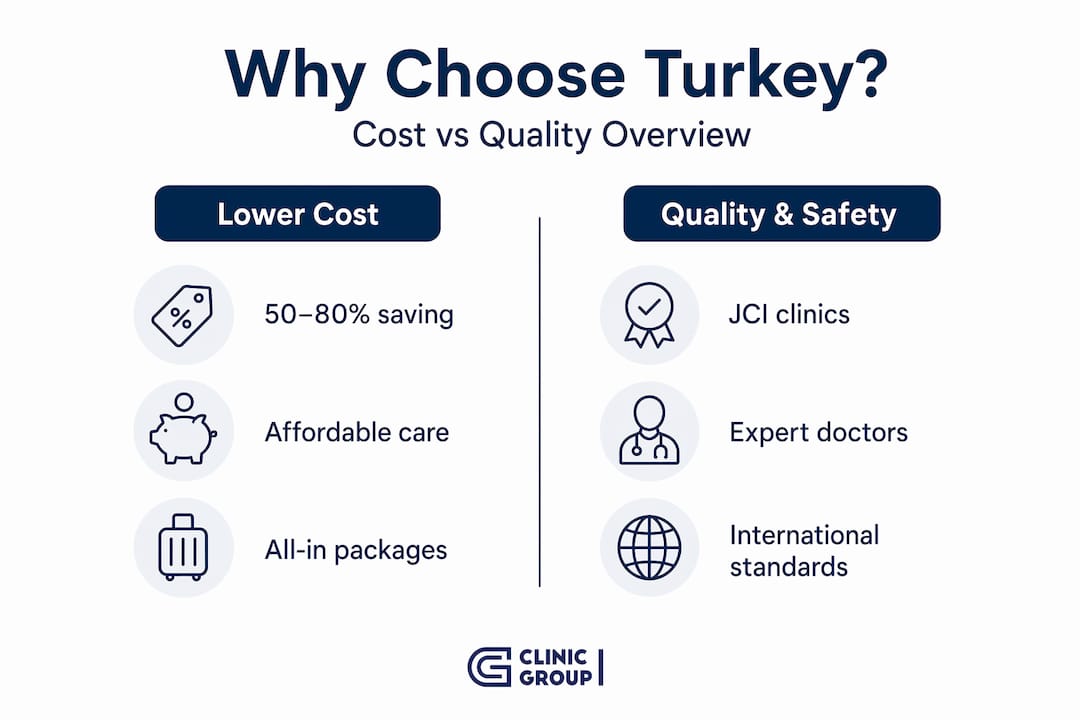
Hair transplants are a clear example. In Turkey, a full procedure typically costs $2,000 to $6,000, compared to $15,000 to $30,000 in the US or UK. Dental treatments, cosmetic surgery, and anti-ageing therapies follow a similar pattern across the board.
The competitive environment also plays a role. Over 500 hair clinics in Istanbul alone compete for international patients, which drives both pricing and service quality upward. Clinics that fail to meet patient expectations simply do not retain their reputation in a market where reviews travel fast.
Key cost advantages at a glance:
- Dental implants cost 60–75% less than UK private clinic prices
- Hair transplant packages include procedure, accommodation, and aftercare at a fraction of Western prices
- Rhinoplasty and liposuction procedures offer comparable savings with board-certified surgeons
- Currency exchange rates often provide additional savings for patients paying in pounds or euros
Quality and safety standards in Turkish clinics
One of the most persistent concerns among European patients is whether Turkish clinics meet acceptable safety standards. The short answer is that the best ones meet and often exceed what patients might expect.
Turkey has 41 JCI-accredited hospitals, placing it among the highest-ranked countries in the world for internationally recognised healthcare accreditation. JCI, or Joint Commission International, is the gold standard in global healthcare quality assessment. Hospitals bearing this accreditation have met rigorous criteria covering patient safety, infection control, surgical protocols, and staff qualifications.
Beyond JCI accreditation, many Turkish clinics carry ISO certifications and operate under the oversight of the Turkish Ministry of Health, which licences medical facilities and monitors compliance. This regulatory framework provides a layer of accountability that protects patients and holds clinics to defined standards.
Turkish doctors frequently hold both local board certifications and international qualifications, often with membership in European or American professional bodies. Many have trained or practised abroad before returning to Turkey, bringing with them techniques and protocols aligned with European standards of care.
| Quality factor | What to look for |
|---|---|
| Accreditation | JCI certification or Turkish Ministry of Health licence |
| Surgeon credentials | Board-certified specialist with verifiable qualifications |
| Facility standards | ISO-certified clinics with documented sterilisation protocols |
| Transparency | Itemised pricing and written treatment plans before booking |
| Patient support | Dedicated international patient coordinators on site |
Our clinic accreditation guide explains in detail what these certifications mean and why they matter when selecting a provider abroad.
Clinical expertise and volume of procedures
Turkey’s reputation in hair transplants, dental care, and plastic surgery is built on volume as much as credentials. When a clinic performs hundreds of a specific procedure each month, the clinical team develops a depth of experience that is genuinely difficult to match in lower-volume settings.
Hair transplants are perhaps the most visible example. Turkish clinics are known for mega-session procedures of 4,000 to 6,000 grafts in a single session, requiring precise planning, skilled extraction, and careful implantation. This level of complexity demands experienced hands.
Critically, qualified doctors must perform the key stages of any hair transplant: hairline design, graft planning, and channel opening. These are clinical decisions with permanent consequences. In the best Turkish clinics, these steps are doctor-led, not delegated to support staff.
The same principle applies to dental and cosmetic procedures. The surgeon who consults with you should be the one performing your treatment, not a technician working under loose supervision. Aftercare protocols at leading Turkish clinics are equally structured, with post-operative instructions, medication plans, and scheduled follow-up built into the standard patient pathway.
Pro Tip: Before committing to any clinic in Turkey, ask specifically who performs each stage of your procedure. Request the name and qualifications of the operating surgeon, not just the clinic’s general credentials.
This kind of patient-centred planning is what separates the best clinics in Turkey from those operating primarily on volume without adequate medical oversight. The Turkey medical tourism advantages that matter most are not just about price. They are about getting the right outcome from a qualified specialist.
Comprehensive support for your treatment journey
For many European patients, the logistics of travelling abroad for treatment are as daunting as the medical decision itself. The good news is that Turkey’s medical tourism infrastructure has developed specifically to address this.
The typical journey for an international patient receiving treatment in Turkey looks like this:
- Initial consultation: A virtual or remote consultation with a clinic coordinator or specialist to assess your case, discuss treatment options, and receive a detailed cost plan before you travel.
- Clinic matching: For patients using a verified platform, this step involves matching your needs to a pre-vetted clinic based on your specific treatment, budget, and preferences.
- Travel and accommodation: All-inclusive packages typically cover the procedure, four or five-star hotel accommodation, private airport transfers, and interpretation services, removing the need to coordinate each element separately.
- Treatment: Procedures are carried out at the clinic with a dedicated coordinator on hand throughout your stay to manage communication and any questions.
- Post-treatment and aftercare: Before departure, clinics provide full aftercare instructions and medication. Remote follow-up consultations allow your clinical team to monitor recovery and address any concerns once you are home.
This end-to-end model means patients are not left to manage complex logistics alone. For more detail on what to expect from your aftercare once you return home, our post-treatment care guide covers the key steps clearly.
How to choose the best clinic in Turkey
Knowing why Turkey is worth considering is one thing. Knowing how to select a safe, reputable provider is what protects your health and your investment.
These are the factors that genuinely distinguish high-quality clinics from those best avoided:
- Accreditation status: Confirm the clinic holds JCI accreditation or a valid Turkish Ministry of Health licence. Both are verifiable through official channels.
- Named surgeon credentials: Your treating surgeon should be board-certified in the relevant speciality. Ask for their qualifications, years of experience, and professional memberships.
- Transparent pricing: Reputable clinics provide itemised quotes covering all aspects of treatment, including anaesthesia, medications, and follow-up appointments. Hidden costs are a warning sign.
- Balanced patient reviews: Look for reviews on independent platforms rather than clinic websites only. Pay attention to how clinics respond to negative feedback. A dismissive response to a complaint tells you as much as a glowing testimonial.
- Doctor involvement in critical steps: As noted earlier, hairline design and surgical planning must be performed by a qualified doctor. Any clinic where technicians carry out these steps without direct medical supervision is one to avoid.
One red flag stands out above the rest. Avoid clinics that promise unlimited grafts without conducting a proper donor evaluation. Safe graft extraction depends entirely on the health and density of your donor area. A clinic that bypasses this assessment is prioritising sales over your safety.
Pro Tip: Use a verified clinic comparison platform to cross-reference accreditation, reviews, and surgeon profiles before making any booking. Our guide on comparing clinic features walks you through exactly what to check.
For patients exploring dental treatments specifically, our guide to safe dental treatment abroad provides additional criteria relevant to dental tourism in Turkey.
My perspective: what working with patients teaches you
I have spent years working with European patients as they navigate the decision to seek treatment abroad, and one pattern stands out clearly. The patients who have the best outcomes are not simply those who found the cheapest option in Turkey. They are the ones who took the time to verify their clinic, asked the right questions, and travelled with realistic expectations.
What I have observed is that Turkey’s quality improvements over the past decade are real and measurable. The country has invested heavily in healthcare infrastructure, international accreditations, and specialist training. The gap between a well-chosen clinic in Istanbul and a reputable private clinic in London is far smaller than most patients assume before they research properly.
The integrated package model matters more than people realise. When accommodation, transfers, and aftercare are built into a single coordinated plan, patients arrive better prepared, feel supported throughout, and recover with far less stress. That continuity of care has a genuine impact on outcomes.
My honest view is this: cost savings in Turkey are real, but they are not the most compelling reason to choose Turkish clinics. The most compelling reason is the combination of experienced specialists, modern facilities, and structured patient support that verified clinics genuinely provide. The savings are a welcome result. The quality is the reason to go.
— Clinic
How Clinicgroup connects you to trusted Turkish clinics
Clinicgroup connects European patients with verified, credentialled clinics across Turkey, supporting each step from initial enquiry to post-treatment follow-up. Every clinic in the Clinicgroup network has been assessed for accreditation, specialist qualifications, and patient care standards, so you are not starting your search from scratch.
Through Clinicgroup, you receive transparent treatment plans with clear pricing before you commit to anything, along with support coordinating travel, accommodation, and language assistance throughout your stay. Whether you are considering dental implants, a hair transplant, cosmetic surgery, or a wellness programme, you can explore verified treatments and browse trusted clinics to find a provider that fits your needs and budget. Start with a free consultation and take the first step with confidence.
FAQ
How much can I save by choosing clinics in Turkey?
International patients typically save 50–80% on medical procedures in Turkey compared to UK and Western European prices, without compromising on outcomes or clinical standards.
Are Turkish clinics safe for European patients?
Yes, when you choose an accredited provider. Turkey has 41 JCI-accredited hospitals, and many clinics operate under strict Turkish Ministry of Health licensing, with board-certified doctors who often hold international qualifications.
What treatments are most popular among European patients in Turkey?
Hair transplants, dental implants, cosmetic surgery (including rhinoplasty and liposuction), and anti-ageing therapies are among the most commonly sought treatments, with Turkey recognised globally for its expertise and volume in each of these areas.
Do Turkish clinics provide aftercare once I return home?
Many leading Turkish clinics offer remote follow-up consultations to support patients after they return home, providing continuity of care and allowing the clinical team to monitor recovery and address any concerns.
What are the red flags to watch for when choosing a clinic in Turkey?
Avoid clinics that promise unlimited grafts without a donor assessment, delegate critical surgical steps to non-medical staff, or provide vague pricing without written treatment plans. These are clear indicators of poor clinical standards.