TL;DR:
- A second medical opinion offers an independent assessment of your diagnosis or treatment plan by a specialist with no prior involvement in your care. It is advisable in complex, serious, or unresponsive cases, especially when exploring international treatment options. Proper preparation, choosing the right specialist, and understanding the process help ensure a productive second opinion that supports confident healthcare decisions.
A second medical opinion is defined as an independent clinical assessment of your diagnosis or treatment plan by a specialist who has had no prior involvement in your care. This second opinion medical guide exists to help you understand when to seek that reassessment, how to prepare for it, and how to act on the results with confidence. Getting a second opinion can confirm your diagnosis, open up alternative treatment paths, and give you genuine reassurance that you are receiving the best care available. For patients considering treatment abroad through platforms such as Clinicgroup, understanding this process is a practical first step toward making informed, confident decisions.
When should you consider getting a second opinion?
Certain clinical situations make seeking a second opinion not just reasonable, but advisable. A second opinion is recommended for elective surgery, rare or life-threatening conditions, or when your current treatment is not producing results. This matters because these are precisely the moments when the stakes are highest and the margin for error is smallest.
The most common triggers for requesting an independent review include:
- An unclear or uncertain diagnosis after initial tests
- A diagnosis of a rare, serious, or life-threatening condition such as cancer or a complex neurological disorder
- A recommendation for major surgery, including elective procedures
- A treatment plan that has not improved your condition after a reasonable period
- Conflicting results across different tests or imaging studies
- A desire to explore clinical trial eligibility or newer treatment options
- A feeling that your concerns have not been fully heard or addressed
Beyond these triggers, there are subtler reasons to seek a further view. Conflicting test results, for instance, do not always mean one result is wrong. They may indicate that the condition sits at a diagnostic boundary where specialist expertise is genuinely needed. Similarly, if you are considering treatment at an international clinic, an independent opinion from a subspecialist adds a layer of verification that protects your interests.
Second opinions may involve extra costs, delays, and occasionally conflicting advice, so your individual needs and preferences should guide the decision. Weighing these factors honestly before you proceed saves time and reduces anxiety later.
Pro Tip: If you have been diagnosed with a condition that affects fewer than 200,000 people in the UK, a subspecialist second opinion is not optional. It is the standard of care.
How to prepare before requesting a second opinion
Preparation is what separates a productive second opinion from a frustrating one. Before you contact any specialist, you need a clear set of goals and a complete set of records. Arriving without either wastes the specialist’s time and your own.
Follow these steps to prepare thoroughly:
-
Write down your specific questions. Be precise. “Is this the right diagnosis?” is less useful than “Are there other conditions that could explain my symptoms alongside this diagnosis?” Documented questions help you schedule appointments abroad or at home with a clear agenda.
-
Compile your complete medical records. This includes all imaging studies, laboratory results, pathology slides, surgical notes, and referral letters. Patients are advised to have their current physician coordinate the direct transfer of imaging files in DICOM format to avoid redundant tests and unnecessary delays.
-
Request a referral or inform your doctor directly. Most doctors expect and welcome second opinion requests. Framing the request as collaboration rather than a challenge to their judgement eases the process and keeps communication open.
-
Check your insurance coverage. Insurance plans often cover second opinions, but coverage varies significantly. Confirm pre-authorisation requirements before booking any consultation to avoid unexpected costs.
-
Decide between virtual and in-person. Virtual consultations suit patients who need a fast turnaround or who are considering international clinics. In-person visits are preferable for complex physical examinations or when tissue samples need to be reviewed directly.
Pro Tip: Ask your GP or consultant to write a brief summary letter alongside your records. A one-page clinical summary helps the reviewing specialist orient themselves quickly and focus on the most relevant details.
Step-by-step guide to obtaining your second opinion
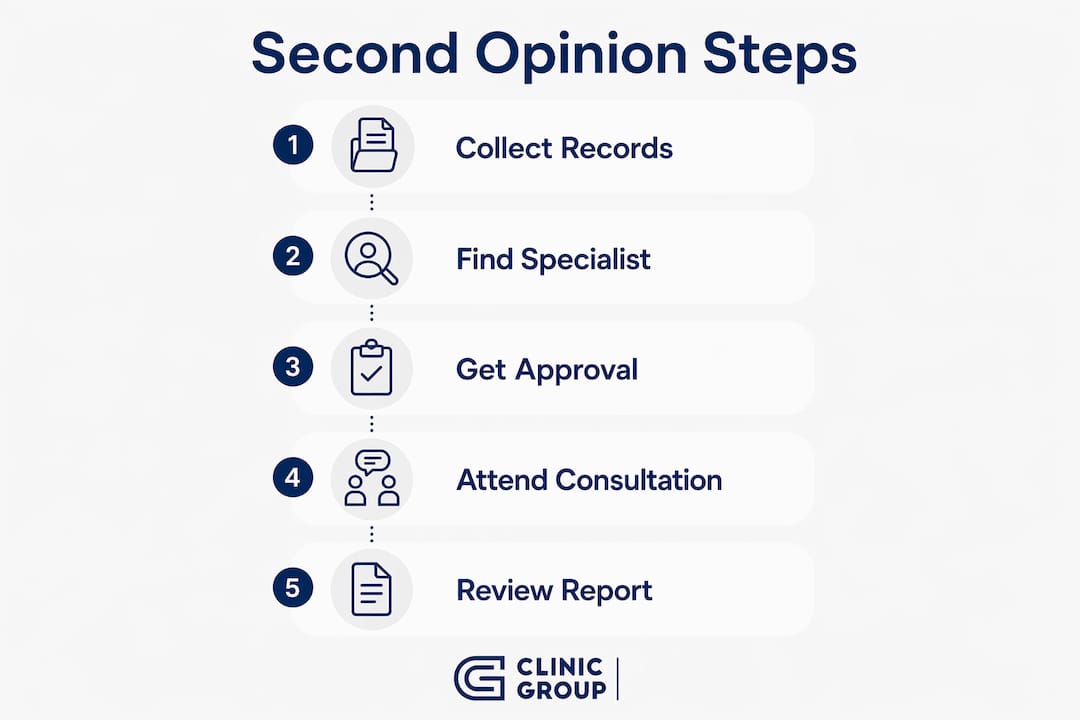
The formal second opinion process follows five recognised stages: records assembly, specialist identification, insurance pre-authorisation, clinical consultation, and report delivery. Understanding each stage prevents the most common pitfalls, which are incomplete records, wrong specialist type, and insurance delays.
Step 1: Collect and organise your records. Request everything from your current provider, including imaging in DICOM format, pathology slides, and all correspondence. Gaps in records are the single most common cause of delays.

Step 2: Identify the right specialist. Selecting a subspecialist with expertise tailored to your specific diagnosis minimises confirmational bias and produces a more independent assessment. A general oncologist and a tumour-specific oncologist, for example, will not always reach the same conclusions. Clinicgroup’s verified clinic network connects patients with board-certified specialists matched to their diagnosis, removing the guesswork from this step.
Step 3: Obtain insurance pre-authorisation. Contact your insurer before booking. Some plans require a GP referral; others accept self-referral. Getting this wrong adds weeks to your timeline.
Step 4: Attend the consultation. Bring your written questions, your records summary, and a trusted person if possible. Take notes or ask permission to record the consultation. A second set of ears reduces the chance of missing key information.
Step 5: Receive and review the report. Most in-person consultations produce a written report within five to ten working days. Virtual programmes typically deliver reports within one week of receiving complete records.
The table below compares the two main consultation formats at a glance:
| Feature | Virtual consultation | In-person consultation |
|---|---|---|
| Typical turnaround | ~7 days after records received | 5–10 working days post-appointment |
| Approximate cost | Flat fee (~£630 / $800) | Varies by clinic and specialist |
| Physical examination | Not possible | Available |
| Suitability | Stable conditions, record review | Complex cases, physical assessment needed |
| Access for international patients | High | Requires travel |
For urgent cases, particularly in oncology, expedited fast-track services exist and should be requested explicitly rather than waiting for a standard appointment slot.
How to understand and act on your second opinion report
The report you receive is a clinical document, not a verdict. Reading it correctly is what turns information into a decision. The report will typically address three areas: whether the original diagnosis is confirmed or revised, what treatment options are available and their respective risks, and any recommendations for further investigation.
When reviewing the report, focus on these points:
- Diagnosis confirmation or revision. If the second specialist agrees with the first, your confidence in the diagnosis is well-founded. If they disagree, you have not reached a dead end. You have identified a genuine clinical question that warrants further discussion.
- Alternative treatment options. A second opinion frequently surfaces treatments the first specialist did not mention, whether because of their subspecialty focus, institutional protocols, or simply different clinical experience.
- Risks and benefits of each option. Compare these directly with what your first doctor outlined. Differences in risk assessment are worth exploring in detail.
Once you have the report, share it with your primary doctor. Experienced specialists welcome second opinions because they consolidate patient understanding and improve adherence to agreed treatment plans. If the two opinions conflict, ask both doctors to review each other’s reasoning. A third opinion is sometimes warranted, though this is the exception rather than the rule.
The emotional dimension of this stage is real. Confirmation brings relief; a revised diagnosis can feel unsettling even when it leads to better care. Give yourself time to process the information before making treatment decisions.
Pro Tip: If you are considering treatment at a Clinicgroup partner clinic following your second opinion, bring both reports to your initial consultation. This gives the treating specialist a complete clinical picture from the outset.
Virtual versus in-person second opinions: which is right for you?
Virtual second opinions have become a practical and widely accepted option, particularly for patients who cannot travel easily or who need a fast result. Virtual second opinion programmes generally provide reports approximately one week after receiving all medical records, for a flat upfront fee. This structure suits patients with stable conditions who need a record-based review rather than a physical examination.
The advantages of virtual consultations are clear for international patients. You submit your records digitally, receive a written report from a specialist at a major medical centre, and avoid the cost and disruption of travel. For patients using Clinicgroup to explore treatment options in Albania or Dubai, a virtual second opinion can be completed before any travel is arranged, giving you a verified clinical basis for your decision.
In-person consultations remain the better choice in specific circumstances. If your condition requires physical examination, tissue biopsy review, or direct imaging interpretation, a specialist needs to see you in person. Complex cases involving multiple systems or ambiguous imaging findings also benefit from face-to-face dialogue, where the specialist can ask follow-up questions in real time.
Before choosing, consider the following:
- How urgent is your situation? Fast-track virtual services exist for oncology cases.
- Does your diagnosis require physical assessment, or is it primarily record-based?
- Are you comfortable submitting sensitive medical documents through a secure digital portal?
- What is your budget? Virtual fees are typically fixed; in-person costs vary widely.
Before travelling for any procedure, checking clinic reviews and verifying accreditation status is a practical step that applies whether you are seeking a second opinion or proceeding to treatment.
Key takeaways
A reliable second medical opinion requires the right specialist, complete records, and a clear plan for acting on the results.
| Point | Details |
|---|---|
| Know when to seek one | Unclear diagnoses, serious conditions, and ineffective treatments are the clearest triggers. |
| Prepare your records fully | Transfer imaging in DICOM format directly to avoid delays and redundant tests. |
| Choose the right specialist | A subspecialist with no link to your first doctor produces the most independent assessment. |
| Virtual is a valid option | Reports arrive within roughly one week and suit stable, record-based cases well. |
| Act on the report together | Share findings with your primary doctor and use both opinions to reach a consensus. |
Why second opinions are one of the most underused tools in patient care
From working with patients across Europe and the Middle East, one pattern stands out consistently. The patients who arrive at Clinicgroup partner clinics most prepared and most confident are almost always those who have already obtained an independent clinical review. They know their diagnosis, they understand their options, and they have a clear basis for their treatment decision.
Seeking a second opinion is a fundamental patient right, yet many patients hesitate because they worry about offending their doctor or appearing difficult. This concern, while understandable, is largely unfounded. Most clinicians actively support the process. The discomfort is in the patient’s mind, not in the consulting room.
What genuinely surprises patients is how often a second opinion does not change the diagnosis but does change the treatment plan. A different specialist may recommend a less invasive procedure, a different drug protocol, or a watchful waiting approach that the first doctor did not consider. That difference can be significant for quality of life, recovery time, and cost.
The practical advice is straightforward. Frame the request as a collaborative step, prepare your records thoroughly, and choose a specialist with no professional connection to your first doctor. If you are considering treatment abroad, use that second opinion as the clinical foundation for every decision that follows.
— Clinic
How Clinicgroup helps you access trusted specialists and follow-up care
Clinicgroup connects patients from the UK and across Europe with verified clinics and board-certified specialists in Albania and Dubai, covering treatments from dentistry and hair transplants to plastic surgery and wellness programmes. If your second opinion points toward a specific treatment, the Clinicgroup treatments directory gives you access to a curated network of accredited providers, with transparent pricing and full support for travel logistics, partner hotels, and aftercare. The platform also assists patients in understanding medical tourism accreditation so you can verify clinic credentials before committing to any procedure. Whether you are at the research stage or ready to book, Clinicgroup’s team is available to guide you through every step.
FAQ
What is a second medical opinion?
A second medical opinion is an independent clinical assessment of your diagnosis or treatment plan by a specialist who was not involved in your original care. It is used to confirm, revise, or expand on the initial findings.
When should you seek a second opinion for a diagnosis?
Seek a second opinion when you receive a diagnosis of a serious or rare condition, when recommended for major surgery, or when your current treatment is not working. Conflicting test results are also a clear indicator.
How long does the medical second opinion process take?
Virtual second opinion programmes typically deliver a written report within one week of receiving complete medical records. In-person consultations usually produce a report within five to ten working days after the appointment.
Does insurance cover the cost of a second opinion?
Insurance plans often cover second opinions, but coverage varies. Confirm pre-authorisation requirements with your insurer before booking to avoid unexpected out-of-pocket costs.
Can you get a second opinion from a specialist abroad?
Yes. Virtual consultations make it straightforward to access subspecialists internationally. Clinicgroup facilitates connections with verified international clinics for patients who wish to pursue treatment or further assessment abroad.