Private vs public clinics in Europe: Key differences
TL;DR:
- Public clinics are funded by taxes and offer low-cost care mainly for residents, not tourists.
- Private clinics provide faster, more flexible services with clear upfront pricing suitable for medical tourists.
- For elective procedures, private clinics often deliver better communication, amenities, and shorter wait times.
When planning dental or medical treatment abroad, many patients assume that all European clinics offer broadly similar services. The reality is far more varied. Whether a clinic is publicly or privately funded shapes everything from how quickly you can book an appointment to whether staff speak English fluently. For anyone considering medical tourism in Europe, understanding these distinctions is not just useful — it is essential for making safe, informed decisions and budgeting accurately. This guide walks through the core differences so you can approach your care with confidence.
Table of Contents
- How public and private clinics are funded and who pays
- Access, waiting times, and availability for overseas patients
- Which clinic type is best for your needs? Comparing public and private care scenarios
- Quality of care, amenities, and language support
- Why efficiency is only part of the story: Our perspective on choosing your clinic
- Find the right clinic for your health journey with Clinic Group
- Frequently asked questions
Key Takeaways
| Point | Details |
|---|---|
| Funding shapes experience | Public clinics are tax-funded; private clinics rely on direct payments or insurance, affecting cost and accessibility. |
| Private offers speed, flexibility | Private clinics usually provide faster access, more language support, and modern amenities—ideal for medical tourists. |
| Public excels in emergencies | For urgent or ongoing treatment, public clinics often provide the best safety net and continuity of care. |
| Hybrid strategies work best | Many patients combine public and private care to balance efficiency, cost, and quality. |
| Check accreditation and support | Always ensure your chosen clinic meets safety standards and offers adequate support for overseas patients. |
How public and private clinics are funded and who pays
Let us begin by exploring the fundamental financial distinctions between the two clinic types. The funding model behind a clinic determines almost everything about how it operates and who it serves.
Public clinics in Europe are funded by taxes and social contributions, offering free or low-cost care at the point of service to residents, while private clinics are funded by out-of-pocket payments or private insurance, resulting in direct patient fees. This is the most important distinction to grasp from the outset.
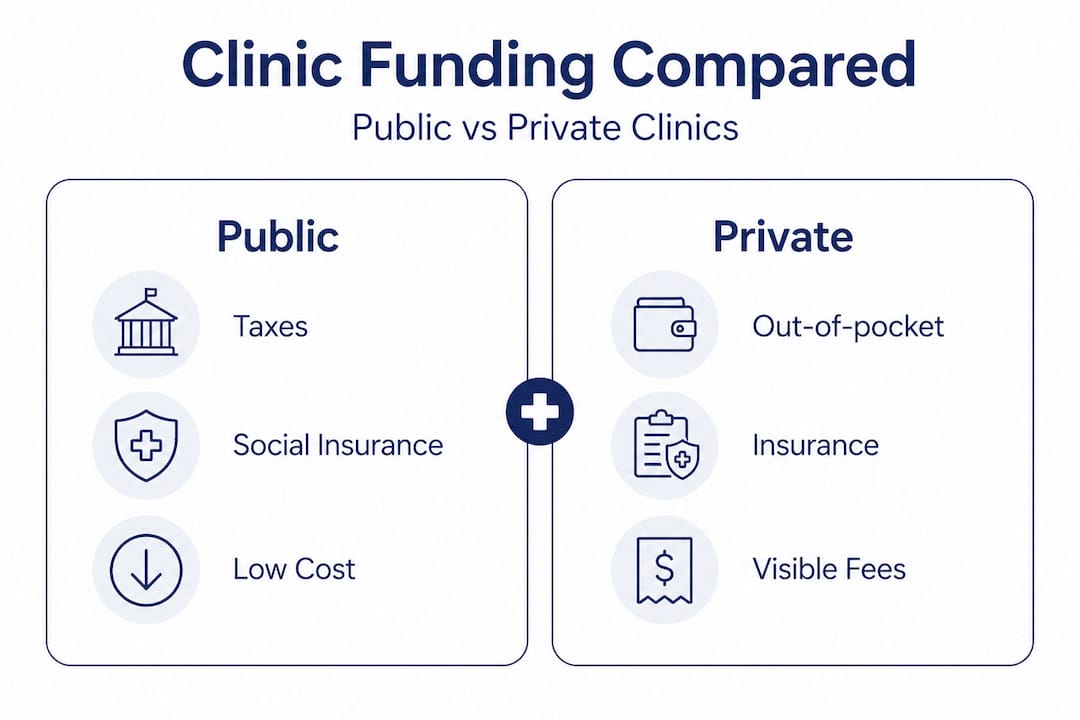
For residents of a given European country, public healthcare can mean little to no cost at the point of treatment. For visitors and medical tourists, however, that entitlement usually does not apply. Most public systems are designed for residents who contribute to the tax base. A British patient travelling to Spain or Croatia for dental work, for instance, will typically be charged the full rate at a public facility, rather than receiving subsidised care.
| Factor | Public clinics | Private clinics |
|---|---|---|
| Primary funding | Government taxes and contributions | Out-of-pocket fees and private insurance |
| Cost to residents | Free or very low | Full market rate |
| Cost to tourists | Often full rate or near full rate | Transparent fixed fees |
| Fee transparency | Variable, often unclear | Usually clear upfront pricing |
| Treatment scope | Broad, focused on essential care | Wide range, including elective and cosmetic |
Private clinics, by contrast, set their own pricing structures. Costs are direct and visible from the start, which many patients find reassuring when planning a trip around a specific procedure. While fees are higher in nominal terms, the clarity around what you pay and what you receive can be a significant advantage when travelling from abroad.
It is also worth noting that higher public financing improves healthcare efficiency at the system level; OECD analysis shows no evidence that private-dominated systems improve overall efficiency. That said, system-wide efficiency does not always translate to a better individual experience for a visiting patient. Understanding both perspectives helps you make a more realistic plan.
For patients ready to begin researching, our trusted clinics directory offers a curated list of verified options across Europe to help you compare facilities with confidence.
Access, waiting times, and availability for overseas patients
With finances clarified, next comes the practical matter of accessing care as a visitor or patient from abroad. Speed and convenience matter enormously when you are coordinating flights, accommodation, and recovery time.
Private clinics offer greater choice of doctors, more flexible scheduling, English-speaking staff, and better amenities, making them particularly appealing for medical tourists. For someone travelling from the UK, this can make a significant difference. Being able to communicate clearly with your specialist, receive treatment within days of arrival, and schedule follow-up consultations remotely are all standard features of well-run private facilities.

Public clinics, on the other hand, operate under significant pressure in many countries. Waiting times for elective procedures can stretch into months, even for residents with full entitlement. For a medical tourist on a fixed itinerary, this level of uncertainty is rarely workable. Emergencies are handled efficiently in public settings, but planned procedures are a different matter entirely.
Rising demand for private care across Europe is driven largely by public wait times, with over 50% of patients willing to increase out-of-pocket spending, particularly in Southern and Eastern Europe. This shift reflects real dissatisfaction with waiting, not just a preference for luxury.
How to maximise your access as a medical tourist:
- Book your private clinic appointment at least four to six weeks in advance, especially for procedures such as implants or elective surgery.
- Confirm that the clinic has English-speaking staff or a dedicated international patient coordinator before committing.
- Request written confirmation of all appointment times, treatment plans, and costs prior to travelling.
- Clarify what happens if a follow-up appointment is needed and whether remote consultations are available post-treatment.
- Check the clinic’s cancellation and rescheduling policy in case your travel plans change.
Pro Tip: If you are combining sightseeing with treatment, schedule your procedure at the start of your trip rather than the end. Recovery time varies, and you want flexibility built into your itinerary rather than rushing a return flight.
Explore private clinics for international care on the Clinic Group platform, or read more about planning your aftercare for medical tourists so you are fully prepared before you travel.
Which clinic type is best for your needs? Comparing public and private care scenarios
Understanding access also means deciding which clinic type fits your personal health journey and reasons for travelling. Not all treatments are equal, and neither are all patient situations.
Public systems are better for emergencies and chronic care, while private clinics are more appropriate for elective procedures. Hybrid use of both systems is also common. Many patients in Europe, including expats and long-term travellers, use public facilities for acute or emergency needs and then turn to private clinics for planned procedures such as dental crowns, hair transplants, or cosmetic surgery.
For most medical tourists, the relevant scenario is elective or planned treatment. If you are travelling specifically for a dental procedure, a dermatological treatment, or a non-urgent surgical intervention, a private clinic will almost always serve you better in terms of scheduling, communication, and patient experience. Public systems are not designed to accommodate non-resident visitors seeking elective procedures; they exist to serve local populations with fundamental health needs.
Private health insurance increases the likelihood of private access by 7.3% for specialist and diagnostic care in Italy, reducing public system usage accordingly. This finding illustrates how insurance changes patient behaviour and broadens access to specialist services. If you hold a travel or international health insurance policy, check whether it covers private care abroad, as this can significantly reduce your out-of-pocket costs.
“The smartest patients do not choose between public and private — they choose the right system for the right situation, and they plan carefully before they travel.”
Scenarios and recommended clinic type:
- Dental implants or cosmetic dentistry: Private clinic, for faster access, clearer pricing, and English-language consultations.
- Emergency dental pain or injury abroad: Public or private emergency services, depending on severity and location.
- Chronic condition management during an extended stay: Public clinics may be more appropriate if you have residency or EU coverage.
- Elective surgery such as rhinoplasty or liposuction: Private clinic, where specialist availability and patient comfort are prioritised.
- Diagnostic tests or second opinions: Private clinics typically offer quicker turnaround times and detailed written reports.
For a thorough overview of how to approach safe dental treatment abroad, or if you want a structured approach to comparing clinic features before committing, both resources offer practical, detailed guidance.
Pro Tip: Always obtain a written treatment plan from your clinic before starting any procedure. A reputable private clinic will provide this as standard, and it gives you a clear record if you need follow-up care at home.
Quality of care, amenities, and language support
Having weighed when to use public versus private care, the finer details of patient experience must also be considered. Quality, comfort, and communication are not minor add-ons — for a patient travelling from abroad, they are central to the entire experience.
Private clinics consistently offer greater choice of doctors, more flexible scheduling, English-speaking staff, and better amenities. This is particularly relevant for British patients, who may struggle in countries where English is not widely spoken in public healthcare settings.
Language barriers in public clinics are a genuine concern. In Southern and Eastern Europe, public hospital staff are not always able to communicate in English at a clinical level. This can create misunderstandings around diagnoses, treatment consent, and aftercare instructions. Private clinics catering to international patients actively recruit multilingual staff or partner with patient coordinators who handle translation and communication throughout the process.
In terms of amenities, private clinics typically offer:
- Modern, well-maintained facilities with up-to-date diagnostic equipment such as digital X-rays and CBCT scanning technology.
- Private consultation rooms and recovery spaces, reducing exposure to other patients and providing a more comfortable environment.
- Dedicated international patient services, including airport transfers, accommodation partnerships, and post-treatment follow-up.
- Clear treatment documentation provided in English, useful for continuity of care when you return home.
- Accreditation from recognised bodies such as the Joint Commission International (JCI) or ISO certification, indicating compliance with international standards.
Public clinics are not necessarily inferior in clinical outcomes — many public hospital specialists are highly skilled and experienced. However, the delivery of care in a public setting is usually more impersonal, the facilities more variable, and the administrative processes less tailored to foreign visitors.
Before booking any clinic, it is worth reviewing the guidance on dental travel tips for managing expectations, and consulting our clinic accreditation guide to understand what certifications to look for before committing to a provider.
Why efficiency is only part of the story: Our perspective on choosing your clinic
With all factors explored, it is important to step back and consider how these choices play out in practice for real patients travelling from the UK and across Europe.
The debate about public versus private healthcare is often framed around cost and speed. But for a medical tourist, the more important question is: which system was designed with someone like me in mind? Public healthcare systems across Europe were built to serve resident populations. They are efficient at managing the health of communities, handling chronic conditions, and responding to emergencies. They were not built to serve a British patient arriving for a five-day dental trip.
Empirical OECD data shows that public financing correlates with better system-level efficiency, and that privatisation risks creating health inequities. This is a vital point of nuance. Encouraging patients to always choose private care is not the same as claiming private care is always superior. The evidence suggests that well-funded public systems produce good outcomes at scale. But that scale-level performance does not automatically serve the individual patient who needs a specific procedure in a short window of time.
In our experience, the patients who get the best outcomes from medical tourism are those who take a hybrid approach deliberately. They use their home country’s public services for initial diagnosis and consultation, then travel for the elective procedure at a trusted private clinic, and return home knowing their GP already has the relevant records. That continuity of information is often overlooked, yet it is one of the most important safety factors in medical travel.
Equity is also worth raising. Access to private care abroad is not available to everyone. The patients who benefit most from medical tourism are those with the disposable income and flexibility to travel, take recovery time, and afford procedures upfront. Acknowledging this does not diminish the value of the option — but it does mean we encourage every patient to plan honestly around their financial situation and health needs, rather than choosing private care abroad simply because it sounds more appealing.
For those preparing to consult a specialist abroad for the first time, the guide on navigating medical consultations abroad is an invaluable starting point.
Find the right clinic for your health journey with Clinic Group
Equipped with this understanding, your next step is to find and contact the ideal clinic for your care. Clinic Group connects patients with a carefully vetted network of private clinics across Europe and the Middle East, covering treatments from dental implants and cosmetic surgery to hair restoration and anti-ageing therapies. Every clinic in our directory has been reviewed for quality standards, patient feedback, and international patient support — so you can browse with confidence rather than uncertainty. You can explore available treatments by procedure type, compare clinic features side by side, and receive guidance from our international patient support team before and after your trip. Visit Clinic Group today to begin your search.
Frequently asked questions
Can foreign travellers use public clinics in Europe?
Most public clinics prioritise residents, and public clinics funded by taxes offer free or low-cost care only to those who contribute to local social systems. Tourists may receive emergency care but often at full cost and with limited services.
Which type of clinic has shorter waiting times for dental procedures?
Private clinics typically offer shorter waiting times for dental treatment. Private clinics offer flexible scheduling and more appointment availability, making them the preferred choice for overseas patients with fixed travel dates.
Are private clinics always more expensive than public clinics in Europe?
Not always in absolute terms, but they do involve direct fees. Private clinics funded by out-of-pocket payments charge transparently for services, whereas public clinics may appear cheaper but often cannot serve non-residents at subsidised rates.
When should you consider using the public system over private clinics?
Public systems are better suited to emergencies and chronic conditions, while elective and non-urgent procedures are generally more accessible and comfortable in private settings. Patients with genuine acute needs should always seek the nearest appropriate public emergency service.
Is insurance needed to access private clinics for treatment abroad?
Insurance is not always mandatory, but it helps considerably. Private health insurance increases access to specialist and diagnostic care by 7.3% in Italy, for example, demonstrating how coverage shifts both eligibility and costs in a patient’s favour.