Getting a certified Albanian–English medical translation accepted by a UK institution comes down to one thing: a complete, signed statement of accuracy attached to a full translation of the original document. Gov that the translator or company must state in writing that it is a “true and accurate translation of the original document”, include the date, and provide their full name and contact details. That is the minimum. Without it, the Home Office, NHS, GMC, or a university admissions office can and will reject the submission.
Before you order anything, do three things:
- Confirm the receiving authority’s exact requirements (GMC, NHS, Home Office, clinic, or university each have slightly different expectations).
- Gather the original document plus a high-quality scan, and note the target use and your deadline.
- Prepare a brief covering note listing the document type, language pair (Albanian to English or English to Albanian), and any abbreviations or units that need special attention.
Pro Tip: Always contact the receiving authority before ordering. A translation rejected for missing a single certificate field wastes both time and money.
Key takeaways
A certified medical translation for UK use must include a signed “true and accurate translation” statement, the date, and the translator’s full name and contact details, with the original document attached.
| Point | Details |
|---|---|
| Certificate wording is mandatory | GOV.UK requires a “true and accurate translation” statement, date, and translator contact details on every certificate. |
| Verify the receiving authority first | GMC, NHS, Home Office, and private clinics each have slightly different acceptance criteria; confirm before ordering. |
| Use qualified, registered translators | CIOL, ITI, or ATC membership signals professional standards and a QA process; check public directories. |
| GDPR applies to medical files | Use a provider with a Data Processing Agreement, encrypted transfer, and a clear deletion policy. |
| Clinicgroup coordinates document readiness | Clinicgroup advises on certificate requirements and coordinates secure file transfer to verified partner clinics. |
Table of Contents
- What does ‘certified’ medical translation mean in the UK?
- Which medical documents commonly need translation for UK use?
- Which UK organisations accept certified translations, and what signals matter?
- What must a translation certificate contain?
- How do you choose a qualified medical translator or company?
- How to prepare and submit medical documents for translation
- What does certified medical translation cost in the UK, and how long does it take?
- Common pitfalls, GDPR, and confidentiality when translating medical documents
- How Clinicgroup supports patients who need translated medical documents
- Planning treatment abroad? Clinicgroup coordinates the paperwork too
- Sources
- FAQ
What does ‘certified’ medical translation mean in the UK?
A certified translation is not a summary, a machine output, or a bilingual note. It is a complete, accurate rendering of every element in the original document, accompanied by a signed certificate. The translator or company attests that the translation faithfully reproduces the source, including annotations, stamps, and legible dates.
GOV.UK’s certifying guidance sets the minimum certificate content: a statement of accuracy, the date, and the translator’s full name and contact details. CIOL and the ATC both recommend using a qualified, registered translator or translation company and attaching a certificate that meets those same fields. The GMC goes further: it expects a full translation, not a summary, submitted alongside the original-language copy.
One important caveat: there is no single, universal UK statutory certification stamp. Acceptance varies by receiving authority. The ATC advises clients to verify the exact format required before ordering, precisely because a certificate that satisfies one body may not satisfy another.
For medical records specifically, ‘complete and accurate’ means:
- All laboratory values, reference ranges, and units reproduced exactly
- Annotations, footnotes, and marginal notes included
- Dates in a clearly readable format with the original date preserved
- Stamps and seals described (not reproduced as images where copyright applies)
- Medication names and dosages translated with the original term retained in brackets
GOV.UK’s migrant health guidance warns explicitly against relying on automated translation tools for clinical documents, noting they cannot provide quality assurance and may affect patient safety.
Which medical documents commonly need translation for UK use?
The range of documents patients and clinicians translate for UK purposes is broader than most people expect. Common types include:
- Discharge summaries and hospital admission records
- Referral letters and specialist clinic reports
- Operative notes and surgical reports
- Pathology, cytology, and histology reports
- Diagnostic imaging reports (X-ray, MRI, CT, ultrasound)
- Prescription and medication lists
- Vaccination records and immunisation certificates
- Consent forms and patient information sheets
- Laboratory results (blood panels, microbiology, serology)
- Dental records, panoramic X-ray reports, and periodontal charts
- Multidisciplinary team meeting notes
- GP summaries and chronic disease management plans
Formatting matters as much as accuracy. Preserve dates, measurement units, and medical abbreviations. Where a document contains a government crest, an institutional logo, or a signature, joint ATC/CIOL/ITI guidance advises indicating their presence rather than reproducing them, to avoid inadvertent copyright issues.
When a single file contains text in more than one language (for example, an Albanian clinic report with embedded English laboratory headers), label each language block clearly and supply the full source pages alongside the translation. This prevents ambiguity about which section has been translated.
Which UK organisations accept certified translations, and what signals matter?
The short answer: GOV.UK sets the minimum certificate content; professional bodies such as CIOL, ITI, and ATC recommend membership and QA processes as trust signals; and clinical regulators such as the GMC and NHS expect complete, accurate translations submitted with the original document.
Key acceptance signals to look for:
- Certificate wording matching the GOV.UK “true and accurate translation” standard
- Translator or company membership of CIOL, ITI, or ATC
- Evidence of a QA process (a named proofreader or medical reviewer)
- Company letterhead with full contact details
- Source document bound with or electronically bundled alongside the translation
- ATC Certification Stamp on the certificate and each page where applicable
FCDO Services note the importance of qualified linguists and secure, official processes for government-facing translations, which reflects the broader expectation across UK public bodies.
DocTranslator is an example of an online translation tool. Like other automated platforms, it does not produce a signed certificate meeting GOV.UK requirements and is not suitable as a standalone solution for certified medical document translation.
What must a translation certificate contain?
GOV.UK guidance and CIOL both specify the same minimum fields. A certificate that omits any of them risks rejection.
The ATC’s 2024 Certification Stamp guidelines recommend that accredited companies attach this signed certificate, bind the source with the translation, and apply a digital stamp to each page of the translated document where used.
To verify a certificate you receive, check these points:
- Full name and contact details are present and verifiable
- Membership of CIOL, ITI, or ATC can be confirmed on the relevant body’s public directory
- The translator can supply a sample project or references in the medical field
- A named proofreader or medical reviewer is identified in the QA process
- The source document is attached or bundled in the same PDF
How do you choose a qualified medical translator or company?
The key differentiator is process competence, not just bilingual ability. A translator who speaks Albanian and English fluently but has no medical subject-matter experience and no QA workflow is a liability for clinical documents. CIOL guidance is clear: prioritise translators or companies that demonstrate medical expertise, QA workflows, and membership of recognised UK professional bodies.
Selection checklist:
- Confirmed membership of CIOL, ITI, or ATC (check the public directories)
- Demonstrable medical translation experience in the relevant specialism
- Willingness to supply a sample translation or professional references
- Written QA workflow naming an editor and, for clinical content, a medical reviewer
- Professional indemnity insurance and clear contract terms
- Stated turnaround time with an escalation process for terminology queries
- Transparent pricing with scope defined in writing (page count, certificate, QA steps)
- Clear data-protection procedures and GDPR compliance statement
Red flags to avoid:
- Machine-only translation with no human review
- Reluctance to supply certificate wording or sign a certificate
- No verifiable contact details or professional membership
- No references or sample work in the medical field
- Inability to bind the source document with the translation
- Vague or absent data-protection assurances
Questions to ask any provider:
- How do you handle medical abbreviations specific to Albanian clinical practice?
- Who performs QA, and is a medical reviewer available for clinical content?
- Can you provide a certificate in English that meets GOV.UK wording requirements?
- How do you handle confidential patient data, and what is your GDPR processor agreement?
How to prepare and submit medical documents for translation
A well-prepared file package reduces queries, speeds up the process, and produces a more accurate result. Follow these steps in order:
- Confirm the receiving authority’s requirements and note the exact certificate wording they expect.
- Gather originals and high-quality scans of every page, including cover sheets, stamps, and any attachments.
- Label each page with a document title and page number; indicate language blocks clearly if the file is multilingual.
- Note clinical abbreviations and units that may be specific to Albanian medical practice, and flag any medication names that differ from UK equivalents.
- Flag sensitive personal data and request secure file transfer (encrypted email, secure portal, or password-protected PDF).
- Agree turnaround and certificate wording in writing before work begins.
For file formats:
- Supply PDF/A or high-resolution PDF as the primary format
- Provide native Word or Excel files only when the translator needs to preserve complex table formatting
- For diagnostic imaging, supply the report as a PDF; DICOM files are rarely needed for translation purposes but should be available on request
Pro Tip: Scan at a minimum of 300 dpi and check that all text is legible before sending. Smartphone photos taken at an angle or in poor light produce OCR errors that delay the translation. Always have a human translator check any OCR-generated text before it is used as a source.
For multilingual documents, supply the full source pages in their original order and add a brief note identifying which sections are in which language. Do not pre-translate any section yourself, as this creates ambiguity about the authoritative source text.
What does certified medical translation cost in the UK, and how long does it take?
Pricing for certified medical document translation varies by language pair, document complexity, medical specialism, and whether a medical reviewer is included. Expect higher rates where rapid turnaround or specialist clinical review is required. Always request a written quote that lists scope, certificate, QA steps, and any surcharges for urgency or formatting.
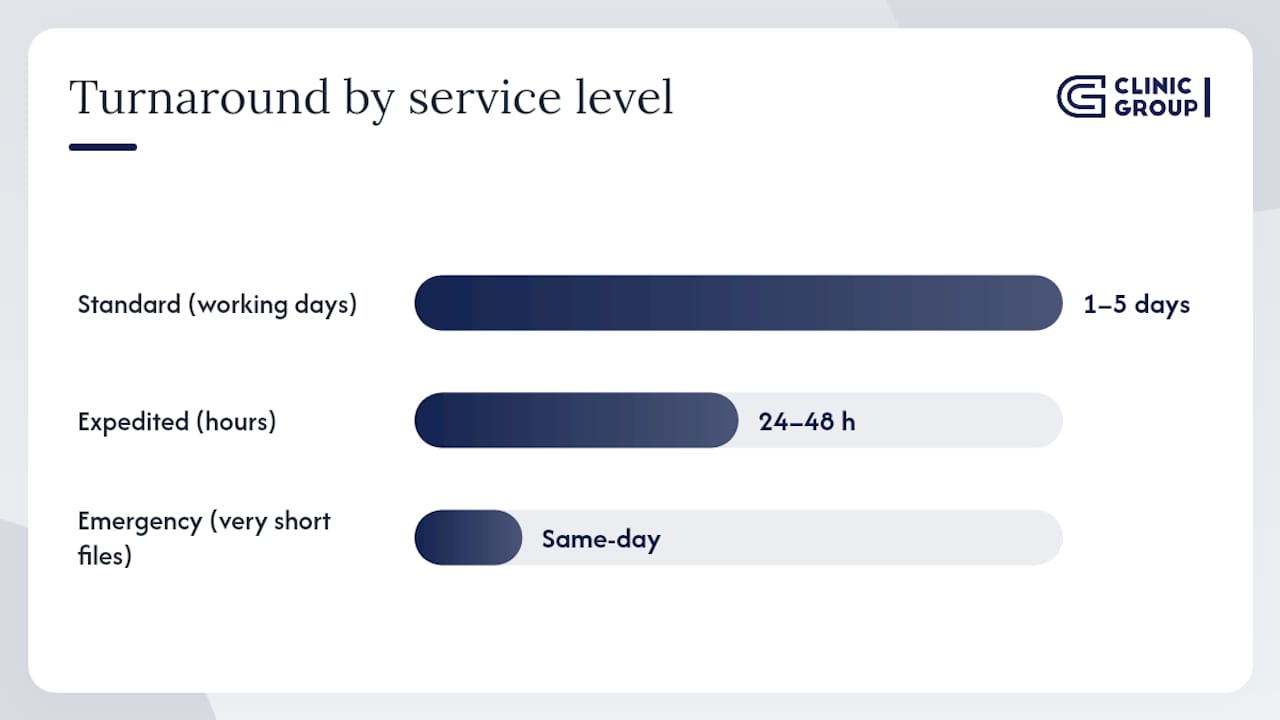
Typical cost and turnaround shapes:
- Standard service (1–5 working days): Suitable for most referral letters, discharge summaries, and lab results. Cost reflects per-word or per-page rates plus a certificate fee.
- Expedited service (24–48 hours): Available for shorter documents; carries a premium. Confirm that QA and certificate steps are still included, not skipped.
- Emergency same-day: Realistic only for very short files (one to two pages). Verify that a medical reviewer is still part of the process.
When requesting a quote, include:
- Total page count and approximate word count
- Scan quality (high-resolution PDF or lower quality requiring OCR)
- Whether a medical reviewer is needed for clinical content
- Certificate format required (paper, digital, ATC stamp)
- Binding or bundling format (PDF bundle, hard copy)
- Secure transfer method required
For patients preparing documents for treatment abroad, guidance on preparing medical records for translation offers a useful patient-facing checklist on file preparation and what to include.
Common pitfalls, GDPR, and confidentiality when translating medical documents
Common pitfalls:
- Accepting machine-only translations without human review or a signed certificate
- Missing annotations, footnotes, or marginal notes that carry clinical meaning
- Incorrect medication names or dosages due to brand-name differences between countries
- Ambiguous dates (DD/MM/YYYY vs MM/DD/YYYY) left unresolved in the translation
- Certificates that lack verifiable contact details or a named translator
Poor translation quality in a clinical context is not merely an administrative inconvenience. GOV.UK’s migrant health guidance explicitly states that automated tools cannot provide quality assurance and may affect patient safety. A mistranslated drug name, an incorrect dosage unit, or a misread laboratory value can influence clinical decisions.
GDPR checklist for medical document translation:
- Use a provider with a signed Data Processing Agreement (DPA) in place
- Apply data minimisation: redact personal identifiers not needed for the translation
- Confirm secure transfer (encrypted email or a secure portal)
- Agree a retention and deletion policy in writing before sharing files
- Request confirmation of deletion or return of files on completion
- Verify the provider’s privacy policy covers medical data specifically
For patients sharing records across borders, secure transfer practices for medical records provides practical steps on protecting privacy when sharing files internationally.
How Clinicgroup supports patients who need translated medical documents
Clinicgroup does not provide translation services. What it does is help patients prepare accepted document packages for partner clinics, advise on certificate wording requirements, and coordinate secure file transfer to verified clinic partners in Albania and Dubai.
For patients booking treatment through Clinicgroup, the practical support includes:
- Clinic matching: connecting patients with verified partner clinics that specify their document acceptance requirements upfront
- Translation checklist support: advising on the certificate fields and QA signals each partner clinic expects
- Secure document coordination: facilitating safe transfer of translated files to the receiving clinic
- Travel logistics: arranging partner hotels, transfers, and pre-treatment consultations
- Aftercare coordination: ensuring post-treatment documentation is handled correctly for follow-up care in the UK
A typical scenario: a patient booking dentistry in Albania needs an English translation of their Albanian dental records for the clinic’s pre-assessment. Clinicgroup advises on the certificate wording the clinic requires, confirms the clinic’s acceptance criteria, and coordinates the handover so the patient arrives with a complete, accepted document bundle.
Patients travelling for hair transplant treatment or plastic surgery face the same documentation requirements. Clinicgroup’s coordination role means patients do not have to navigate each clinic’s individual requirements alone.
For broader guidance on organising medical travel, Clinicgroup’s resources cover the full logistics from first consultation to aftercare.
Clinicgroup’s perspective on getting medical translations right
The single most common mistake patients make is assuming that any bilingual translation will be accepted. It will not. Receiving authorities, from the GMC to a private clinic in Tirana, look for specific certificate wording, verifiable translator credentials, and evidence of a QA process. Getting those three things right before submitting saves weeks of delay.
Clinicgroup’s advice is straightforward: confirm the receiving authority’s requirements first, obtain a full signed certificate from a CIOL, ITI, or ATC-registered provider, and keep the original document bound with the translation at every stage. If you are booking treatment abroad and need help coordinating the document side of your preparation, contact Clinicgroup and we will guide you through what each partner clinic needs.
Planning treatment abroad? Clinicgroup coordinates the paperwork too
Preparing a complete, accepted document bundle for a clinic abroad takes more than a good translation. It requires knowing exactly what each receiving clinic expects, how to transfer files securely, and how to keep originals and translations together throughout the process.
Clinicgroup connects patients from the UK with verified clinics in Albania and Dubai across dentistry, hair transplants, plastic surgery, non-surgical aesthetics, and anti-aging treatments. For patients who need translated medical records as part of their pre-treatment assessment, Clinicgroup advises on certificate requirements, coordinates secure document transfer to partner clinics, and handles the travel logistics so you arrive prepared.
To find out which treatments are available and what document preparation your chosen clinic requires, visit the Clinicgroup treatments page or contact the team directly to discuss your situation.
Sources
Confirm the receiving authority’s exact requirements before ordering a translation. The sources below are the primary references for UK certified medical translation:
- Translating documents that aren’t in English - General Medical Council
- Gov
- ATC certification stamp guidelines (2024) - Association of Translation Companies
- Guidance on Certified Translations | CIOL
This article is general information, not a substitute for advice from a qualified doctor. Consult a qualified healthcare professional about your own circumstances before acting on anything here.
FAQ
What is a certified medical translation in the UK?
A certified medical translation is a complete, accurate translation of a medical document accompanied by a signed certificate stating it is a “true and accurate translation of the original”, dated and including the translator’s full name and contact details, as required by GOV.UK.
Does the GMC accept Albanian medical documents without a certified translation?
No. GMC guidance requires that documents not in English be submitted with the original-language copy and a complete, accurate English translation; summaries are not acceptable.
Can I use Google Translate or an automated tool for medical documents?
No. GOV.UK’s migrant health guidance advises against automated translation tools for clinical documents because they cannot provide quality assurance and may affect patient safety.
How do I verify that a translator meets UK requirements?
Check that the translator or company is a registered member of CIOL, ITI, or ATC using their public directories, and confirm they can supply a signed certificate meeting GOV.UK wording, evidence of a QA process, and verifiable contact details.
How can Clinicgroup help with medical document translation for treatment abroad?
Clinicgroup advises patients on the certificate requirements of each partner clinic, coordinates secure document transfer, and handles travel logistics. Clinicgroup is not a translation provider but connects patients with the information and clinic contacts they need to arrive with an accepted document bundle.