The dentistry abroad process, done correctly, follows a clear sequence: verify the clinic and treating dentist independently, secure a fixed written quote with a guarantee, transfer your dental records and involve your UK dentist, travel for treatment, then return with a documented aftercare plan. The General Dental Council (GDC) is explicit that it cannot guarantee the standards of overseas clinics, which means the verification work falls entirely on you before you book. Savings on larger cases such as multiple implants or full-arch work can be substantial, though value depends on clinic quality rather than destination alone.
Before you travel, confirm these six things:
- The treating dentist’s registration number with their national regulator (and GDC registration if they consult in the UK)
- Clinic accreditation from the national health authority, JCI, or an equivalent recognised standard
- A single, itemised, fixed-price written quote covering all stages of treatment
- A written guarantee for the work, transferable and clearly worded
- Published patient reviews and, where available, documented case outcomes
- A continuity-of-care plan agreed with your UK dentist
Table of Contents
- What does the dentistry abroad process look like, step by step?
- How do you verify the clinic and treating dentist before booking?
- What should you prepare before travelling?
- What happens at the clinic on treatment day?
- How is aftercare handled once you return to the UK?
- What do typical costs and timelines look like?
- What red flags should make you pause or walk away?
- Key takeaways
- Why a safety-first process is the only sensible starting point
- How Clinicgroup supports your dental treatment abroad
- Useful sources and further reading
- FAQ
What does the dentistry abroad process look like, step by step?
A well-managed overseas dental treatment typically unfolds across five stages. The table below shows the sequence, the key actions at each stage, and a realistic timeframe.
| Stage | Key actions | Typical timeframe |
|---|---|---|
| Research and shortlisting | Verify clinic accreditation; read independent reviews; request lead clinician CVs | Several weeks before booking |
| 2. Pre-booking checks | Obtain fixed written quote; confirm materials/brands; review written guarantee and aftercare terms | About one to two weeks before booking |
| Consultations and records transfer | Remote or UK pre-consultation; transfer X-rays and medical history; involve UK dentist | Several weeks before travel |
| 4. Treatment visit(s) | Arrive, consent checks, procedure, immediate recovery, discharge instructions | A typical treatment stay ranges a few nights for most cases; staged implants often require two trips |
| Return and follow-up | Planned aftercare schedule; UK dentist review; complication protocol in place | Patients should book a UK dentist review soon after returning |
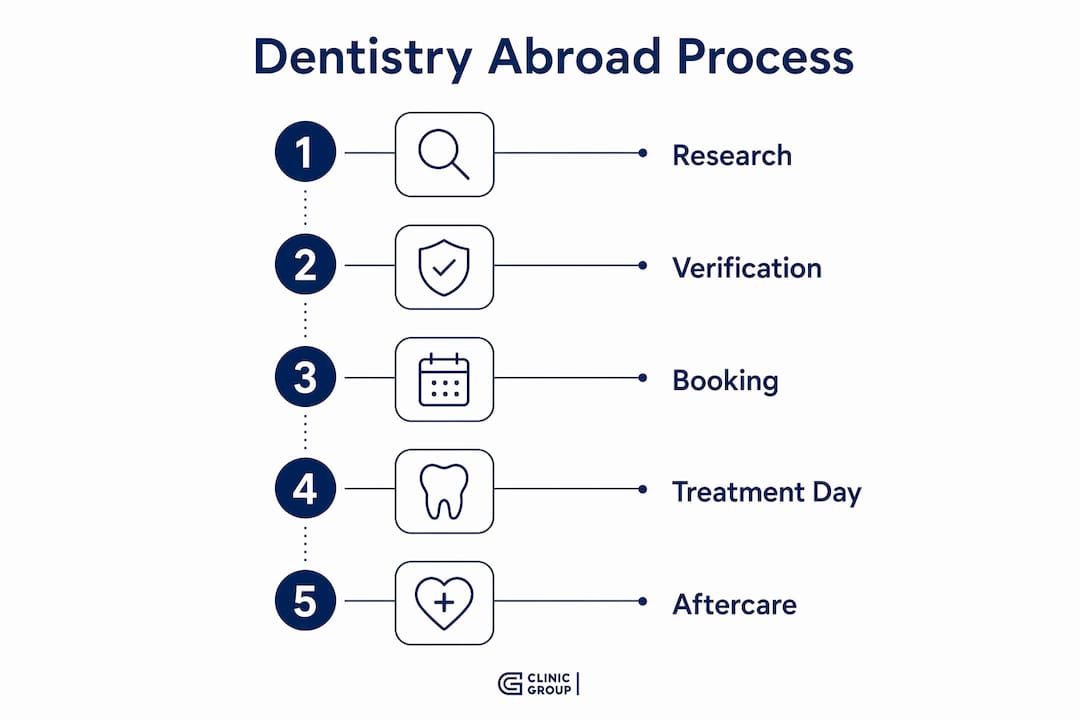
For straightforward procedures such as crowns or veneers, a single trip of a few nights is usually sufficient. Implant cases involving bone grafting typically require two visits: one for placement and one for the final restoration, separated by a healing period of several months. Plan both trips before you book the first.
How do you verify the clinic and treating dentist before booking?
The GDC advises that dental regulation varies significantly by country, and that patients should research whether a professional regulatory body exists at the destination and whether registration with it is compulsory. That research starts with a few direct questions to the clinic.
- Ask for the lead clinician’s full name, registration number, and specialist qualifications in writing.
- Check the national Ministry of Health or dental regulator’s online register to confirm the registration is current.
- Request the clinic’s documented complaints and rework policy — a reputable clinic will share this without hesitation.
- Ask for example case notes or outcome data for the specific procedure you need.
Dental Health guidance stresses that independent verification of qualifications matters as much as the consultation itself. Patient reviews on independent platforms add a further layer of evidence; look for volume, recency, and specific clinical detail rather than generic praise. A clinic with strong reviews but no verifiable registration data is still a risk.
Pro Tip: Ask for a full materials list in writing, including the implant brand and crown material. Check whether the brand has a European distributor and a warranty programme — this matters if you need a replacement component in the UK years later.
What should you prepare before travelling?
The NHS treatment abroad checklist recommends speaking to your GP or dentist before travelling and notes that NHS reimbursement is not available for dental treatment abroad. Your EHIC or GHIC covers only medically necessary care during a visit, not planned procedures. Specialist travel medical insurance is therefore not optional.
A proper pre-travel consultation should cover your full medical history, smoking status, current medications, any history of general anaesthetic reactions, and an imaging review, typically an OPG X-ray or CBCT scan. If the clinic cannot review imaging before confirming a treatment plan, that is a warning sign.
| Document | What it must include |
|---|---|
| Fixed written quote | All consultations, scans, materials, final restorations, discharge medication, and foreseeable aftercare |
| Written guarantee | Duration, scope, what remedial work is covered, and who bears the cost of return travel if rework is needed |
| Clinician credentials | Full name, registration number, specialist title, and the regulatory body that issued it |
| Imaging and medical history | Copies of your X-rays and a summary of your dental and medical history to carry with you |
| Appointment confirmation | Dates, clinic address, emergency contact number, and hotel arrangements |
Check foreign travel advice on GOV.UK for entry requirements and any restrictions on carrying prescription medications into your destination country.
Pro Tip: Standard travel insurance policies rarely cover planned procedures or complications arising from them. Look for a policy that explicitly covers medical treatment abroad and includes repatriation cover.
What happens at the clinic on treatment day?
On arrival, a reputable clinic will carry out identity checks, take a signed informed consent form specific to your procedure, and conduct a brief pre-operative assessment before any work begins. You have the right to read the consent form carefully, ask questions, and decline any element you are not comfortable with. Itemised invoices and copies of your imaging and materials documentation should be available on request.
“You should always be assessed by a qualified dentist before being given a treatment plan and cost estimate.” — General Dental Council patient guidance
Assess the clinical environment when you arrive. Visible accreditation certificates, staff wearing identification, and clear sterile-workflow practices (sealed instrument pouches, single-use items) are all signs of proper standards. If anything looks inconsistent with what was described during the consultation, raise it before treatment begins.
Pro Tip: If sedation or general anaesthetic is part of your plan, ask to meet the anaesthetist or sedation lead before the procedure. Confirm their qualifications and check that the clinic holds the appropriate licence for administering sedation.
How is aftercare handled once you return to the UK?
The greatest single risk in dental tourism is a lack of continuity of care. Arrange a formal continuity plan before you travel, not after.
- Confirm the name and direct contact details of your aftercare lead at the clinic.
- Get the written guarantee in plain language: what is covered, for how long, and how remedial costs are handled.
- Agree the timeframe for returning for adjustments if needed, and clarify who bears the cost of a return trip.
- Brief your UK dentist before you travel so they have your records and can act quickly if complications arise.
Your UK dentist should carry out a planned review within 2–4 weeks of your return. Contact them immediately if you experience signs of infection, prosthesis failure, or unexpected pain.
Warning: If a clinic refuses to provide a written aftercare plan or declines to name a specific aftercare contact, do not proceed. This is one of the most consistent warning signs seen in patient complaints about overseas dental care.
Pro Tip: Ask the overseas clinic to send a full clinical summary, including materials used and post-operative instructions, directly to your UK dentist. This avoids any gap in records and speeds up any follow-up care.
What do typical costs and timelines look like?
Always insist on a single fixed, fully inclusive quote rather than a line-item estimate that can grow. A trustworthy quote covers consultations, scans, materials, the procedure itself, discharge medication, and any foreseeable aftercare visits.
Independent guidance consistently notes that savings are most meaningful on larger cases, and that the cheapest high-volume clinics are a common pattern in patient complaints. Quality of clinic matters more than the country.
| Line item | Should be included in a fixed quote |
|---|---|
| Initial consultation and imaging | Yes |
| Procedure and materials (named brand) | Yes |
| Temporary restorations (where applicable) | Yes |
| Discharge medication | Yes |
| Follow-up visits during the stay | Yes |
| Written guarantee documentation | Yes |
For a single implant, a typical stay is a few nights. A typical implant treatment usually involves separate visits spaced months apart after the healing period. Full-arch cases usually require two treatment visits each lasting several nights. Build both into your budget from the outset, including accommodation and flights.
Pro Tip: Compare the cost of dental treatment abroad against UK private fees for the same procedure, including two return flights and accommodation. The saving on multi-implant or full-arch work is often significant; on a single crown, the margin narrows considerably.
What red flags should make you pause or walk away?
- Pressure to book immediately or “limited-time” pricing before a full clinical assessment has been completed.
- No named lead clinician, refusal to share registration numbers, or inability to confirm registration with the national regulator.
- A vague or missing written guarantee, no clear aftercare plan, or refusal to include materials and brand information in writing.
- Superficial consultations: no imaging review, no full medical history taken, or a treatment plan issued within minutes of first contact.
- Clinics that cannot or will not answer the GDC’s recommended patient questions about qualifications, success rates, and complaints procedures.
Key takeaways
The dentistry abroad process is safe and cost-effective when it is built on independent verification, a fixed written quote, and a continuity-of-care plan agreed with your UK dentist before travel.
| Point | Details |
|---|---|
| Verify before you book | Check the treating dentist’s registration with the national regulator and confirm clinic accreditation independently. |
| Fixed quote, written guarantee | Insist on a single all-inclusive price and a transferable written guarantee before confirming any appointment. |
| Involve your UK dentist early | Transfer records and agree a continuity plan before travel; book a review shortly after returning. |
| Red flags to act on | Walk away from any clinic that pressures you to book, refuses to share registration details, or cannot provide a written aftercare plan. |
| Clinicgroup for verified matching | Clinicgroup connects UK patients with verified clinics, manages logistics, and supports aftercare coordination throughout the process. |
Why a safety-first process is the only sensible starting point
The conversation around dental tourism often focuses on price. That framing misses the point. The patients who have the best outcomes are not necessarily those who found the cheapest clinic; they are the ones who treated the verification process as seriously as they treated the treatment itself.
What many guides understate is how much the continuity-of-care gap matters in practice. A UK dentist who has no record of what materials were used, which implant system was placed, or what the post-operative instructions were is working blind if something goes wrong six months later. That is not a hypothetical risk; it is a documented pattern in complaints about overseas dental care. The fix is straightforward: share records in both directions, before and after treatment, and make sure both your overseas clinic and your UK dentist are part of the same plan.
Clinicgroup’s position is that verified clinic matching and coordinated aftercare are not optional extras. They are the foundation of a process that actually protects patients.
How Clinicgroup supports your dental treatment abroad
For UK patients who want the savings of overseas dental care without the uncertainty of researching clinics independently, Clinicgroup offers a structured alternative. The platform connects patients with verified partner clinics, coordinates appointment scheduling, arranges partner hotel accommodation, and supports aftercare planning from the first enquiry through to post-treatment follow-up.
Dental Med Austria Tirana, one of the verified clinics in the Clinicgroup network, offers implants and cosmetic dentistry to international patients and is an example of the clinic-profile transparency the platform provides: named specialists, documented services, and clear patient-facing information.
To see the full range of dentistry options in Albania available through the network, or to request a clinic match and an initial consultation, visit the Clinicgroup contact page and a patient coordinator will be in touch.
Useful sources and further reading
- GDC: Going abroad for dental treatment — official guidance on verifying dentist registration and understanding your rights
- NHS: Treatment abroad checklist — pre-travel steps and reimbursement information
- TravelHealthPro: Travelling for treatment (medical tourism) — NaTHNaC guidance on medical fitness to travel and destination health checks
- Dental Health: Going abroad for dental treatment — independent risk guidance and consultation standards
- GOV.UK: Foreign travel advice — entry requirements, medication rules, and destination safety
- Clinicgroup: Dentistry in Albania — verified clinic options and treatment information for UK patients
- Clinicgroup: Dental Med Austria Tirana — example verified partner clinic profile
This article is general information, not professional dental or medical advice. Confirm current regulations and your personal suitability for treatment with your UK dentist or GP before making any decisions.
FAQ
Does the NHS cover dental treatment abroad?
No. The NHS treatment abroad checklist confirms that reimbursement is not available for dental treatment abroad, and your EHIC or GHIC does not cover planned procedures.
How do I check a dentist’s registration before travelling?
Use the GDC’s online register at gdc-uk.org to check any dentist consulting in the UK, and verify the treating dentist’s registration with the national dental regulator in the destination country.
What should a fixed written quote include?
A proper quote covers all consultations, scans, named materials, the procedure, temporary restorations where applicable, discharge medication, and any foreseeable follow-up visits during your stay.
How does Clinicgroup help with the process?
Clinicgroup matches UK patients with verified partner clinics, coordinates appointments and accommodation, and supports aftercare planning, so patients have a structured process rather than researching independently.
When should I contact my UK dentist after returning?
Book a planned review within 2–4 weeks of returning, and contact your UK dentist immediately if you experience signs of infection, unexpected pain, or prosthesis problems before that appointment.