Choosing a deep plane facelift abroad involves more than selecting a destination. It means deciding whether the proposed operation suits your aims, whether the clinical team communicates clearly, and whether the arrangements work for you as a UK patient. These decisions deserve time and careful consideration, especially when treatment takes place away from home.
Clinic reviews and treatment packages can provide useful context, but they are only part of the picture when considering a deep plane facelift abroad. Focus on how each option fits your circumstances, what evidence supports your decision and whether the full plan is clear. A careful comparison helps separate practical detail from broad promotional claims.
This guide considers how to approach those decisions, from assessing providers and patient feedback to thinking through travel and recovery planning. It also explains how to compare destinations without relying on generalised rankings. Use the information to prepare for discussions with a surgical team and decide which questions you need answered before taking a next step.
Key Takeaways
- Assess a surgeon’s experience with the specific facelift technique, the consultation process and how clearly they explain the proposed plan.
- Read clinic reviews for detail about communication, aftercare and recovery, rather than relying on star ratings alone.
- When considering additional facial surgery, discuss how procedures may affect the treatment plan and recovery together.
- Compare treatment packages by what they include, from hospital arrangements to accommodation and follow-up support.
- Plan your time abroad and return journey around recovery, and understand how support will continue once you are back in the UK.
Choosing a Clinic for a Deep Plane Facelift Abroad
A deep plane facelift repositions deeper facial tissues rather than tightening only the skin. It may be considered when facial sagging is a concern, but only an individual medical assessment can determine whether the technique is appropriate for you.
Assessing surgeon credentials and results
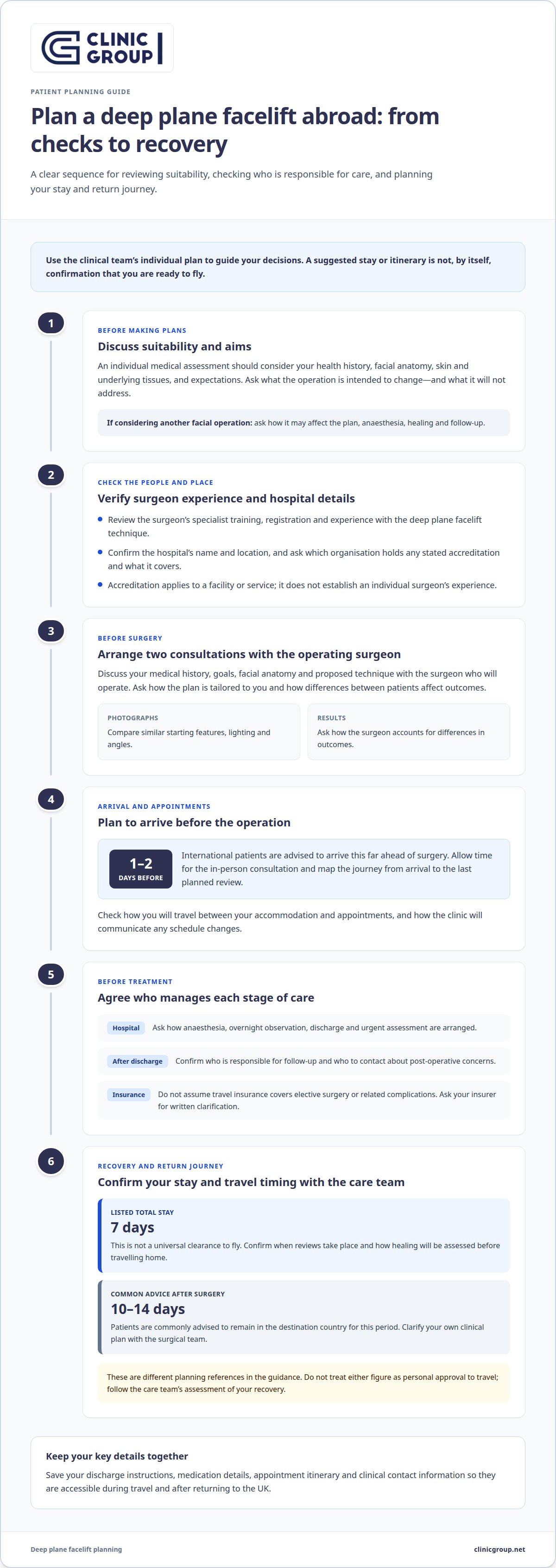
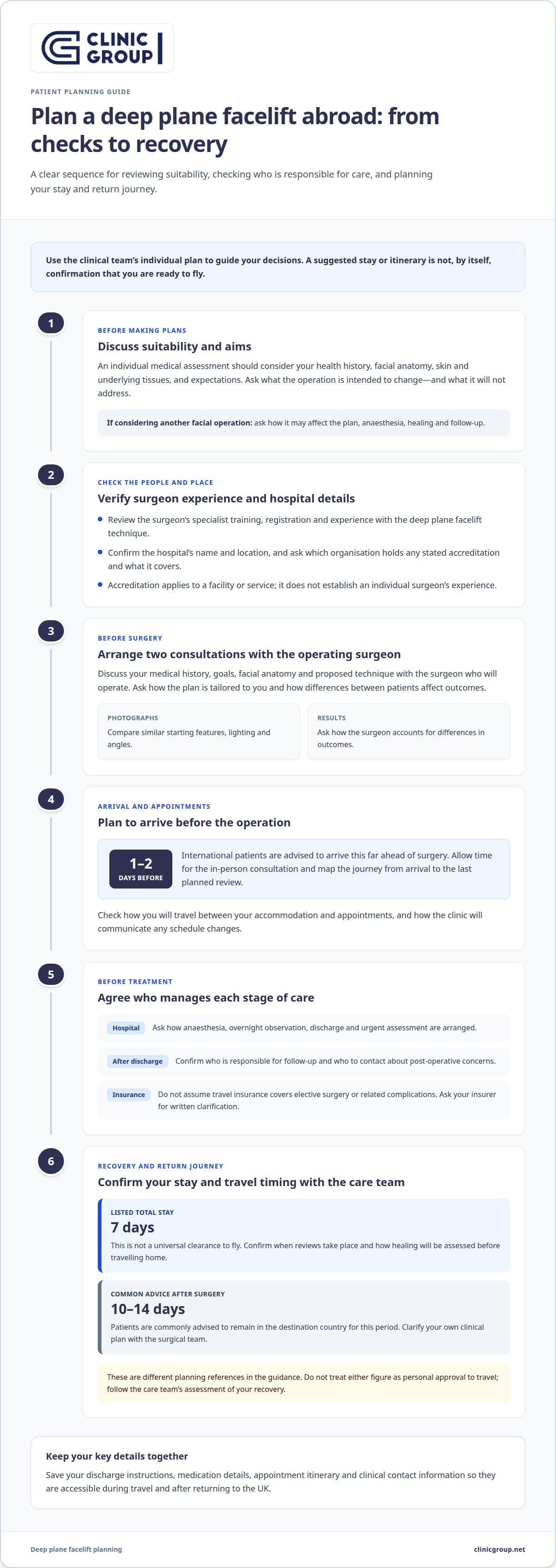
Review the surgeon’s specialist training, registration and experience with deep plane facelift procedures. Before surgery abroad, arrange two consultations with the surgeon who will operate. Discuss your medical history, goals, facial anatomy and the proposed technique. Before-and-after photographs can help you assess results, but compare similar starting features, lighting and angles. Ask how the surgeon accounts for differences in patients’ outcomes.
Checking hospital accreditation
Confirm the hospital’s name and location, then establish which organisation holds any stated accreditation and what it covers. Accreditation applies to a facility or service; it does not prove an individual surgeon’s experience. Ask how surgical care, anaesthesia, overnight observation and urgent assessment are arranged, and who is responsible at each stage, including after discharge.
Assessing suitability and combined procedures
A deep plane facelift may be considered for facial sagging, but an assessment should take account of your skin, underlying tissues, health history and expectations. The surgeon should explain the intended changes and what the operation will not address. If you are considering another facial operation, such as eyelid surgery, ask how combining procedures affects the plan, anaesthesia, healing and follow-up. Each procedure should have a clear clinical rationale.
Travel timing should follow the clinical plan. A listed total stay for a deep plane facelift is 7 days, but this is not a universal clearance to fly. Confirm when reviews take place and how the surgeon assesses healing before your return journey. Allow the care team to guide travel timing according to your recovery, rather than relying on a standard itinerary.
Understanding risks and complications
Ask the surgeon to explain possible complications, how to recognise them and who would manage them. No single complication rate describes every patient: the procedure, personal health and the way complications are counted all affect any figure. Ask what outcome information measures and how it applies to your case. Do not assume travel insurance covers elective surgery or related complications. Ask your insurer for written clarification about planned treatment and post-operative problems abroad, and identify the clinical contact for concerns after returning to the UK.
Choosing a clinic and assessing reviews
Choosing a clinic involves more than ratings. Consider what patient feedback actually describes and how the arrangements fit an international journey. Reviews can help you identify questions to ask, but cannot establish whether an operation is suitable for you.
Assessing clinic reviews
Look for reviews describing specific stages, such as the initial consultation, communication with the surgical team, discharge and follow-up. Compare accounts of similar procedures and note whether patients explain their starting concerns and recovery. Detailed feedback may show how a clinic handled practical questions, but a rating alone cannot establish the quality of an individual surgeon’s clinical judgement.
Notice what reviews say about communication when plans change. For example, an account explaining how a patient received revised appointment details provides more context than a brief statement of general satisfaction. Treat photographs and testimonials as supporting information, not proof that your result will be the same.
Checking clinic safety and accreditation
Confirm the hospital where surgery will take place and identify which organisation holds any stated accreditation. Ask what the accreditation covers: recognition of a facility does not confirm an individual surgeon’s experience. Find out how the hospital arranges anaesthesia, admission, discharge and contact for post-operative concerns. Clear answers show who is responsible at each stage.
For international travel, map the journey from arrival to the last planned review. Allow time for the in-person consultation before surgery; international patients are advised to arrive 1-2 days beforehand. Check how you will travel between accommodation and appointments, and how the clinic communicates if the schedule changes. The practical plan should account for clinical appointments as well as flights.
Accommodation and hospital stays are separate arrangements. Confirm who organises transfers, how you will get to the clinic for reviews and where you will stay after discharge. A hotel booking does not provide medical observation, so clarify the care arrangements after leaving hospital. Keep your itinerary and appointment details together.
Recovery support for international patients
Plan for clinical reviews, communication after discharge and practical support during recovery. Before travelling for surgery, agree who is responsible for each part of your care.
Finding support during recovery
Before departure, find out how the surgical team will respond to post-operative questions. Ask which contact route to use, what information to provide and how urgent concerns are assessed. Keep discharge instructions, medication details and contact information together so they are easy to access during travel and after returning home.
Patients are commonly advised to stay in the destination country for 10 to 14 days after surgery. Plan that period around clinical reviews rather than accommodation alone. A companion can help with everyday tasks during early recovery, when comfort or movement may be limited. Agree the review schedule and return travel arrangements with the treating team.
Reviewing recovery package and aftercare
Read package details carefully and distinguish clinical follow-up from hotel, transport and other travel arrangements. Some assistance packages include an online check-up with the plastic surgeon one month after surgery. Find out how that appointment is arranged and what to do if a concern arises before the scheduled review.
Request written instructions covering wound care, medicines, activity and follow-up. Instructions vary by operation and incision placement, so follow the plan prepared for your treatment. Keep a record of review appointments and advice received. This will help you explain your care history if another clinician becomes involved after you return to the UK.
Understanding the recovery timeline
Initial recovery after a deep plane facelift may take 2 to 3 weeks. Medical specialists advise that it could take up to 6 to 9 months to see the full effect of a facelift. These timelines describe different stages: early healing comes before facial tissues have fully settled and the final appearance becomes clear.
Plan work, social commitments and travel around your recovery, not a fixed calendar. Follow the treating surgeon’s instructions about activity, including exercise and strenuous tasks. Before leaving, organise copies of relevant treatment records and make sure you know how to contact the surgical team with later questions.
Managing bruising during recovery
Bruising after a facelift may remain visible for at least 2 weeks. This can affect comfort and confidence during early healing, so allow flexibility in social plans. Follow the clinic’s written advice about dressings, rest and any compression garment, and attend the reviews arranged for your recovery.
If a change concerns you, contact the clinical team rather than comparing your progress with another patient’s experience. Before travelling home, clarify how the team can assess concerns and share relevant records. This gives you a practical way to discuss recovery after discharge and once you are back in the UK.
All-inclusive treatment packages
An “all-inclusive” label does not tell you what a facelift package covers. Compare the written inclusions, exclusions and travel arrangements before assessing the overall offer.
Checking treatment package inclusions
Start by confirming whether the proposed treatment is a deep plane facelift alone or includes a neck lift. Then review the stated hospital stay, accommodation, transfers and planned follow-up separately. One listed facelift package includes one night in hospital and five nights in a hotel. This illustrates why you should compare package contents item by item.
Check whether the quoted arrangements cover the full planned stay, including any extra nights advised after review. Find out who organises transfers between the airport, hotel and hospital, and whether arrangements change after discharge. A package may combine travel logistics with surgical care, but each item should be clearly described in writing. Keep the treatment plan and itinerary together when reviewing the offer.
Understanding facelift quote inclusions
A written quote should identify the proposed procedure and specify which clinical elements it covers. Look for clear details about the surgeon, anaesthesia, hospital admission, post-operative reviews and any facial rejuvenation proposed alongside the facelift. If a neck lift or another operation is discussed, check whether the quote includes it in the plan or treats it as a separate procedure.
Ask for the quote to separate clinical care from accommodation and transfers. It should also explain how changes after the in-person assessment affect the treatment plan. This makes it easier to compare like with like, rather than weighing one surgical fee against a package with a broader list of services. Keep the written quote, not just a verbal summary.
Comparing costs with travel and accommodation
A useful comparison between treatment in the UK and abroad goes beyond the headline surgical fee. Compare the full itemised total, including the operation, flights, accommodation, local transfers and planned length of stay. Time abroad affects hotel and travel arrangements, while the surgical plan determines which clinical services should appear in the quote.
Create a side-by-side comparison using the same categories for each option. Include hospital and hotel nights, transport to appointments, follow-up before departure and arrangements for any additional stay. A lower surgical quote may cover fewer components, so compare the total financial commitment against the complete itinerary and treatment plan.
Before deciding, match every written inclusion to a named service or arrangement. Separate confirmed items in the treatment plan from optional additions, and record how changes would be handled. This helps UK patients compare packages by their actual scope while keeping surgical care, accommodation and travel clearly distinct.
Countries offering deep plane facelifts abroad
For UK patients comparing destinations for a deep plane facelift abroad, the choice is about more than a country name. Assess the specific clinic, surgical arrangements, travel plan and follow-up pathway together. Clinic Group’s partner network is concentrated in Albania, with a small number of partner clinics in Dubai, UAE.
Tirana, Albania is the main location represented in the partner network. For a cosmetic procedure there, assess the named hospital, the surgeon who will perform the operation and the planned reviews. A destination is only useful if those details align with your treatment plan. Confirm how appointments, transfers and accommodation fit around the clinical schedule.
Dubai, UAE is represented by a smaller number of partner clinics. Apply the same comparison criteria rather than assuming a familiar city guarantees a suitable plan. Check which facility performs the surgery, who leads the assessment and how the clinic handles communication after discharge. Prioritise the care you need, not just your travel preference.
The UK is a useful reference point because you will return there for everyday life and support. Compare overseas arrangements with the practicalities of having consultations, surgery and follow-up in one place. For either Albania or Dubai, map the journey from arrival through pre-operative assessment, operation, early review and return travel. The sequence matters more than a short flight or appealing itinerary.
Avoid comparing countries through broad claims about aesthetic standards or cosmetic results. “Deep plane” describes a surgical approach, not a national standard. Instead, compare the named surgeon’s relevant experience, the proposed operation and the clinical setting. Ask whether a combined procedure changes the plan or recovery arrangements. These details separate the treatment itself from destination marketing.
Use a consistent checklist for each location:
- Identify the surgeon and hospital responsible for the operation.
- Record where consultations and post-operative reviews take place.
- Map transfers between the airport, accommodation and clinic.
- Confirm how the team communicates after you return to the UK.
If you are choosing between Albania and Dubai, look for a coherent clinical and travel plan. A city’s name cannot establish whether an operation suits your facial needs or how follow-up will work. Compare the written treatment plan and care pathway before weighing convenience, focusing on the surgical team, facility and continuity of support.
Clinic Group
Clinic Group helps UK patients researching facelift treatment abroad explore plastic surgery provider listings and medical tourism treatment guides. These can help you take the next step after considering the surgeon’s credentials, treatment plan, travel arrangements and recovery pathway.
Clinic Group’s partner clinics are located almost entirely in Albania, with a small number in Dubai, UAE. Use the listings and guidance to explore relevant options, then discuss your medical suitability and proposed procedure directly with the treating clinic. Clinic Group connects patients with clinics; it does not provide surgical treatment, and outcomes cannot be guaranteed.
If you would like help exploring the available information for your plans, contact Clinic Group.
Take a considered next step
Choosing a deep plane facelift abroad is a significant personal decision. Start with a clear discussion of your goals, health history and expectations. Ask how the proposed plan relates to your facial concerns and what questions remain before you decide.
Clinic Group’s Dental Treatment Directory, Hair Transplant Referrals and Plastic Surgery Provider Listings help patients explore treatment information and listed providers. For facelift research, focus on the plastic surgery information relevant to your plans, then discuss clinical suitability and the proposed procedure with the treating team.
Take the time you need to make an informed decision. Start with clear information and a conversation that addresses what matters to you.
Frequently Asked Questions
What is a facelift?
A facelift is an operation that changes the appearance of the face by repositioning or removing tissue and adjusting skin. The technique depends on the areas being treated and your facial features. It does not address every sign of ageing, such as changes in skin texture. During your assessment, ask the surgeon which concerns the proposed operation addresses and what it leaves unchanged.
What is the difference between a deep plane facelift and a SMAS facelift?
Both techniques work on deeper facial tissues, but surgeons differ in how they release and reposition them. “SMAS” refers to the superficial musculoaponeurotic system, a layer beneath the skin. “Deep plane” describes an approach that works beneath this layer. Since technique names can be used differently, ask the surgeon to explain the planned steps and how they relate to your facial anatomy.
How should patients compare facelift destinations?
Compare the clinical plan and continuity of care, rather than ranking destinations by promises of superior results. Consider who performs the operation, where it takes place, how you will communicate with the team and what happens if plans change. Assess travel practicality and follow-up after you return to the UK. A destination is suitable only if its clinical pathway fits your needs.
Where is the best place for a facelift?
There is no single best destination for every patient. The right choice depends on the surgeon’s relevant experience, the hospital setting, your individual assessment and how follow-up is organised. Clinic Group’s partner network is concentrated in Albania, with a smaller number of clinics in Dubai. Compare the specific providers and care arrangements available in those locations, not broad claims about a country.
How do payment plans and financing options work for procedures abroad?
Payment arrangements depend on the clinic and any separate finance provider involved. Clinic Group does not offer in-house patient financing. Before committing, establish who receives each payment, when it is due and how cancellation or a change in the treatment plan affects the terms. Review any finance agreement independently, including its repayment conditions, before booking surgery or travel.
Which countries are popular for deep plane facelifts abroad, and why?
Popularity alone cannot show whether a clinic or operation is right for you. Clinic Group’s listed partner locations are mainly in Albania, particularly Tirana, with a smaller number in Dubai. Compare these locations for access to listed plastic surgery providers, while weighing the individual surgeon, hospital, travel arrangements and follow-up pathway. Choose based on the care plan, not a country’s reputation.
How can UK patients check a surgeon’s qualifications and experience with deep plane facelifts?
Ask for the surgeon’s full name, specialist qualifications, registration details and experience with the proposed technique. Check that their registration can be matched to the relevant professional authority in the country where the operation will take place. Discuss the surgeon’s role from consultation through follow-up and ask for examples of comparable cases. This helps distinguish the operating surgeon’s credentials from general clinic marketing.
What clinic accreditation and patient safety standards should UK patients look for abroad?
Identify the hospital where the operation will take place and establish which organisation, if any, accredits it. JCI stands for Joint Commission International, an accreditation relating to hospital quality and patient safety. Accreditation is one part of your assessment, not a substitute for understanding the care pathway. Ask how the facility handles anaesthesia, monitoring, discharge instructions and communication between the surgical team and hospital staff.

Article by
Clinic Group Editorial Team
The Clinic Group editorial team publishes clear, practical guides for UK and EU patients researching medical travel — from dental implants and hair transplants to plastic surgery and eye care — with a focus on verified clinics, transparent “from” pricing, and safe planning.
Disclaimer
This article is for general information only and is not medical advice, diagnosis, or a substitute for an in-person consultation with a qualified clinician. Treatment suitability, risks, timelines, and costs vary by individual. Clinic Group connects patients with independent clinics; those clinics are responsible for clinical care. Always verify credentials, obtain a written treatment plan and itemised quote, and confirm aftercare arrangements and travel insurance cover (elective procedures are often excluded) before booking. Outcomes cannot be guaranteed.